
The Quebec Conference
In October 1864, delegates from across British North America gathered in Quebec City to hammer out the terms of a union. A month earlier prominent politicians from the separate colonies of Nova Scotia, Prince Edward Island, New Brunswick, Newfoundland and Canada had met in Charlottetown and convinced each that it was in their best interest to create a federation.
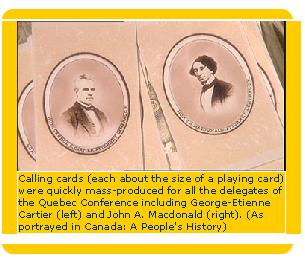 |
The delegates at the Quebec Conference had the daunting task of
spelling out the terms of Confederation. |
|
| If Confederation went through, the British
government had promised to provide a large, low-cost loan, allowing the
new nation to link up the separate lines in Nova Scotia, New Brunswick and
Canada. The meetings at Quebec were held in secrecy. No press was allowed but notes were taken by delegates. The key concept of federalism - the idea that the central government would be granted certain powers while the provinces retained others - was molded into shape. The Quebec Conference went on for three weeks dominated by debate and proposals during the day and parties at night. On October 14, there was a Delegates' Ball for 1,400 people held at Parliament House where they danced to the 25th Regiment's String band and dined on partridge, lobster salad and tongue. According to one account of the Ball, the evening began as a tableau of "grace, loveliness and politeness." But by four in the morning had descended into mayhem with the "supper floor covered with meat drink, and broken bottles." |
|
|
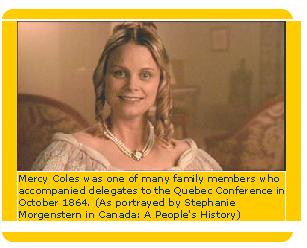 |
After another ball, Feo Monck, the Governor
General's sister-in-law, gleefully reported on Macdonald's erratic
behaviour: "He is always drunk now, I am sorry to say, and when some
one went to his room the other night, they found him in his night shirt,
with a railway rug thrown over him, practicing Hamlet before a looking
glass." Despite the vigorous and eclectic social calendar, Macdonald did much of the actual work on the constitution, drafting 50 of 72 resolutions. He was the only one at the conference with a background in constitutional law. "As it is, I have no help," he told his friend Sir James Gowan. "Not one man of the conference (except Galt in finance) has the slightest idea of Constitution making. Whatever is good or ill in the Constitution is mine." By the end of the Quebec Conference, a basic constitution had been drafted but not without dissent and dissatisfaction among some of the colonies. |
|
| The Great Enterprise: The Road to Union screened 21 January 2001. Extracted from history.cbc.ca, 10 October 2003. |
Credits
for Episode 8. |
|
